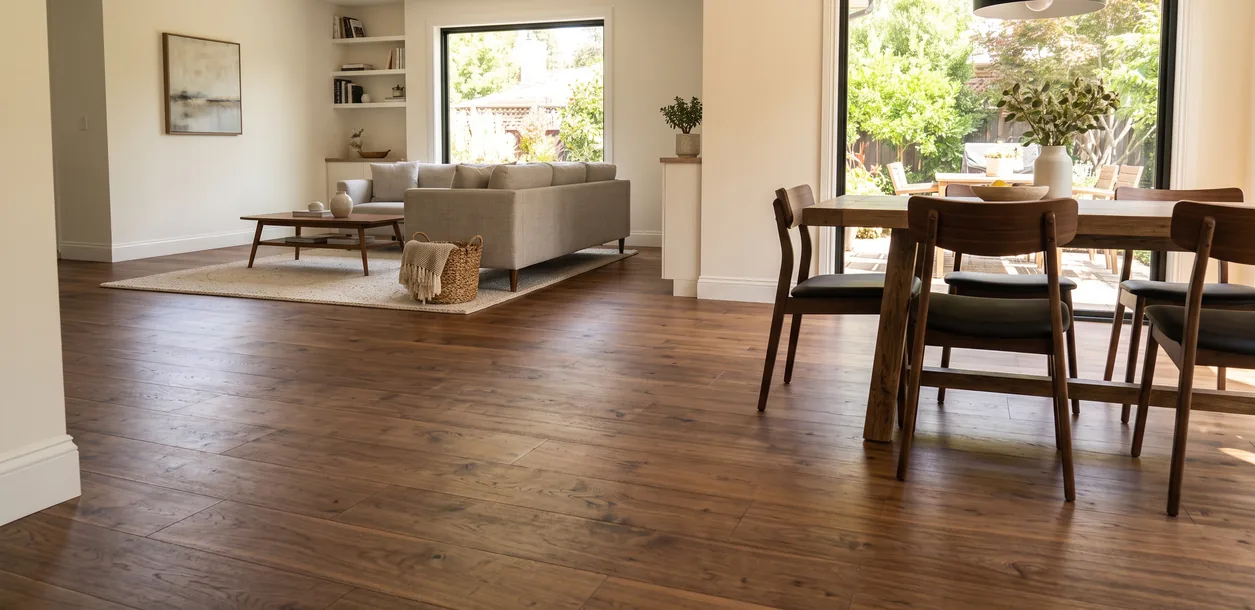
Engineered hardwood flooring
Typically $11.50–$16.50 per square foot installed · 20–50 years · poor against water
What it is
Engineered hardwood is a veneer of real wood, from one to six millimeters thick, bonded to a plywood or fiberboard core. The surface is indistinguishable from solid wood because it is wood. The core is what changes the rules: it moves far less with humidity, it can be glued or floated over a concrete slab, and it can go in a basement that solid wood cannot.
Cost
Typically $11.50–$16.50 per square foot installed at national averages, materials and labor together; the full range runs $9–$19. Typical installed cost is the middle half of the national range, materials and labor at average rates. Builder-grade product with the cheapest crew runs under it; premium product with a specialist runs over. Engineered Hardwood Cost covers what moves it, and the calculator adds removal, prep, stairs and trim for your square feet.
Installation
Floated with clicking edges, glued to a slab, or nailed to a wood subfloor. Acclimation still matters, less than for solid. Prefinished almost always; site finishing a thin veneer is a risk.
Durability
The same finish as solid hardwood, so the same wear. The veneer thickness sets how many times it can be refinished: a 2 mm veneer never, a 4 mm one once or twice, a 6 mm one like solid.
Water resistance
Better than solid, still wood. A spill is fine, a flood is not. Bathrooms and laundry rooms remain a poor idea; a kitchen with a mat at the sink is common.
Maintenance
The same as solid: sweep, damp-mop, refinish when the veneer allows. No sealing.
Pros
- Real wood on a concrete slab and in a basement
- Moves much less than solid wood in humid or dry air
- Wider planks are stable in engineered form
- Floats or glues without a nailer
Cons
- A thin veneer cannot be refinished, so the floor has one life
- Costs as much as solid wood at the good end
- The core can swell if water reaches it
- Cheap versions with paper-thin veneers give the category a bad name
Best rooms
- Living areas on a slab
- Finished basements that stay dry
- Condos
- Whole-house wood in a humid climate
Worst rooms
- Bathrooms
- Laundry rooms
- Unfinished basements
Pets
Same surface as solid, same claw marks. Choose a hard species and a matte finish, and accept some character.
Kids
The same as solid. Wipe up spills, put a rug where they play.
DIY
A floated click product is a realistic weekend project over a flat subfloor. Glue-down over a slab is messier and less forgiving.
Lifespan
Twenty to fifty years, set by the veneer. Ask for the thickness in millimeters, not the words "thick wear layer".
Alternatives
Hardwood, Luxury vinyl, Laminate. Solid vs Engineered Hardwood
Who should buy it
- You want real wood over a slab, in a basement, or in a humid climate
- You want wide planks that stay flat
- You want to float the floor yourself
Who should not
- The room gets wet
- You want a floor that can be refinished for generations
- Your budget is under $7 a square foot installed
Where it ranks
A top-three pick for: for resale value.
Getting it quoted
What a good hardwood quote includes, and the three questions to ask every contractor before you compare prices.
The failure modes, the care schedule and the buying guide for engineered hardwood are on FlooringFAQ. This page is the decision; that one is the education.
Don’t start with the flooring. Start with your home.
Eight questions about the rooms, the household, the subfloor and the budget. A ranked shortlist with the reasons, the watch-outs and a project estimate.
8 questions · about 2 minutes · no obligation
Ready for engineered hardwood quotes?
A hardwood quote should name the species, the width, the grade and the finish, and say whether the finish happens in a factory or in your living room. It should price the subfloor prep separately, say how long the wood will acclimate in the house before it is nailed, and put the sanding schedule in writing if it is site-finished.
No obligation. You choose whether to contact the professionals who respond.